

Before a client has a portal login, a document upload, or an email thread with you, they have a phone call. For most Canadian mortgage brokers, that first call is the entire origin of the relationship, and it happens on a personal cell phone with nothing behind it.
That means the call has no record. The details live in whatever the broker scribbled down. If it went to voicemail and the broker was busy for two days, it is often simply gone, and neither the broker nor anyone else knows a potential client was lost.
This post is about treating the phone as infrastructure rather than a personal habit. What a broker phone setup should do, what the Canadian legal constraints actually are, and how to think about the economics.
Short answer: A Canadian mortgage broker’s phone system should give you a business number separate from your cell, ring wherever you are, record and transcribe calls with notice to the caller, and turn every unknown inbound call into a lead with a callback task. The first call is where most files start, so it should be the first thing on the file rather than something you remember.
Why the personal cell fails
It works fine for one broker with a light pipeline. It fails at three specific points, all of which arrive at once as volume grows.
Missed calls disappear silently. A missed call from a number you don’t recognize is indistinguishable from a wrong number or a robocall. There’s no triage. Brokers routinely discover months later that a referral called, got voicemail, left nothing, and went elsewhere. This is the single largest invisible leak in most broker businesses.
Nothing about the call is retrievable. Two months later, when a client says “you told me the penalty would be about four thousand,” you have no way to check what you actually said. Neither does your compliance reviewer.
The number belongs to the person, not the business. When an agent leaves a brokerage, the client relationships attached to their cell number leave with them. Brokerages that have never confronted this discover it during a departure, which is the worst possible moment.
What a broker phone system should do
Six capabilities. In rough order of how much they matter.
1. Ring your browser and your cell at the same time
The realistic constraint is that brokers are mobile. A system that only rings a desk phone or only rings a browser tab will be missed constantly and abandoned within a month.
The right behaviour is a simultaneous ring: an inbound call rings your computer and your mobile at once, and whichever you answer first takes the call. This is what makes a business number practical for someone who is at a closing, in a car, or at their desk on any given hour.
2. Turn missed calls into leads instead of nothing
This is the capability with the clearest revenue attached. When an unknown number calls and doesn’t reach you, the useful outcome is a contact record, whatever the caller said in voicemail, and a callback task in your queue.
Modern setups go further: transcribe the voicemail, read the intent out of it, create the contact with a name and a reason, and file the follow-up. What used to be a red badge you cleared without thinking becomes a lead in your pipeline with a next action attached.
The corollary matters too. Spam and robocalls should create nothing. A system that files a callback task for every scam warranty call is worse than no system, because you’ll stop trusting the queue.
3. Record and transcribe, then summarize
Recording is the raw material. The transcript is what makes it searchable. The summary is what makes it useful, because nobody re-reads a 25 minute transcript.
A good post-call flow produces a short summary of what was discussed and what was agreed, attached to the client’s file, plus any follow-up tasks the call created. The broker’s job becomes reviewing and correcting rather than writing notes from memory an hour later.
There is a temptation to do this live, with real-time transcription during the call. Our experience is that live transcription is worse on every axis that matters: the transcript quality is lower, it costs more per minute, and reading text while conducting a conversation makes you a worse listener. Post-call processing produces a better record at a fraction of the cost.
4. Click to call from anywhere in your system
If placing a call requires copying a number into a phone, the call log will have holes in it. Every phone number rendered anywhere in your platform should be clickable, and the resulting call should thread to that contact automatically.
5. Handle after-hours properly
Business hours, in your own timezone, with a branded voicemail outside them. Brokers work across provinces; a system that assumes one office timezone will send Alberta callers to voicemail at 3pm Mountain because someone configured it in Toronto.
6. Keep the number with the business
Provisioned to the brokerage or the platform account, not to the individual’s personal carrier contract. This is the property that makes agent transitions survivable.
The Canadian legal picture
Three things brokers ask about, answered plainly.
Call recording is legal, with obligations. Canada is a one-party consent jurisdiction under the Criminal Code, so a participant in a call may record it without the other party’s permission. That is the criminal law answer and it is not the whole answer. PIPEDA governs the recording once it exists: it is personal information, and the accepted standard, reinforced by provincial regulator expectations, is that you notify callers that calls are recorded. Announce it at the start of the call. Retain recordings under a defined policy rather than forever by default, and be prepared to provide a client access to their own recording if they ask.
CRTC rules apply to outbound dialing, not to returning a call. The Unsolicited Telecommunications Rules and the National Do Not Call List govern telemarketing. Returning a call to someone who contacted you, or calling an existing client about their live file, is not telemarketing. Cold-calling a purchased list is, and brokers should not be doing that anyway. If you run outbound campaigns to people you have no relationship with, get advice specific to that before you start.
Your provincial regulator cares about records. FSRA in Ontario, BCFSA in British Columbia, RECA in Alberta and their counterparts all expect brokers to substantiate what was disclosed to a client and when. A call summary attached to a file is a much stronger position than a broker’s recollection. This is the quiet compliance argument for recording that most brokers don’t consider until they need it.
The economics
Broker phone systems are cheap relative to what they protect, but the pricing models differ enough to matter at brokerage scale.
The two cost drivers are the per-number monthly fee and per-minute usage. For a broker doing a normal volume of client calls, expect the all-in cost per broker per month to land somewhere in the low tens of dollars. The larger swing factor is transcription: carrier-provided transcription is typically billed at a steep per-minute rate, while running transcription yourself against a modern speech model costs a small fraction of that. On a brokerage of 30 agents, that difference alone is the whole budget.
The question to ask a vendor is not “what does the number cost.” It’s “what does a 20 minute recorded and transcribed call cost.”
Where BrokerPlus lands
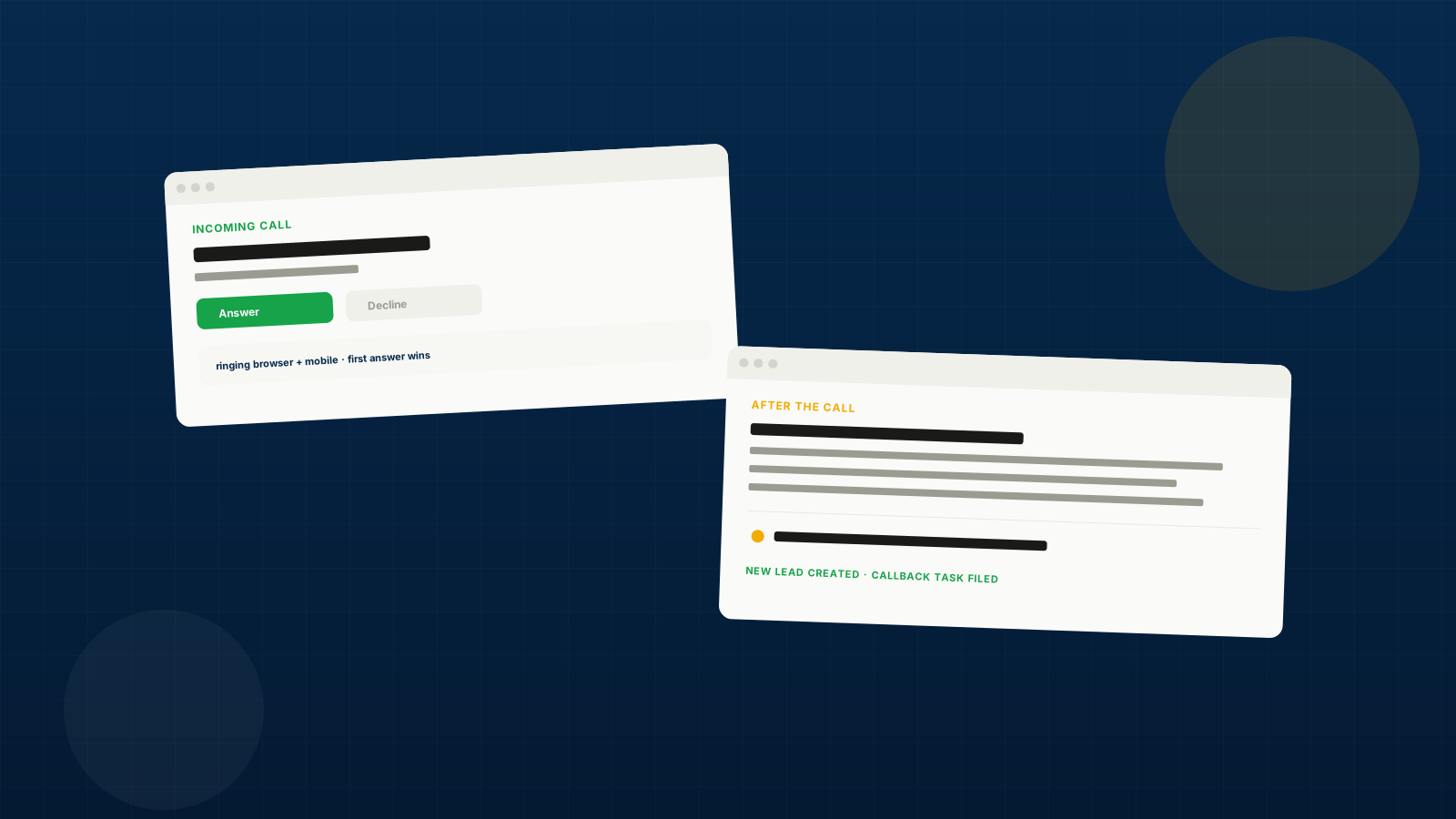
BrokerPlus issues each broker a number and runs the dialer in the browser, mounted globally so a call survives navigating between deals. Inbound calls during your business hours ring the browser and your cell simultaneously, first answer wins; outside hours they go to branded voicemail. Every phone number in the platform is click-to-call, and the active call sits in a dock with mute, hold, keypad, recording pause, and transfer.
Calls are recorded to our own storage, transcribed, and separated into speaker turns, then summarized onto the client’s file with any follow-up tasks created. Unknown inbound callers are triaged after the call: genuine enquiries become a contact with the name and intent extracted and a callback task filed, spam creates nothing. Because calls live on the same timeline as email and texts, the call is part of the client’s history rather than a separate log.
The call is also where the file starts. The summary lands on the deal inside the BrokerPlus origination system, so what the client said on the first call is already on the file when the application comes in, not retyped from notes.
Frequently asked questions
Can I keep my existing number?
Usually. Number porting from a Canadian carrier to a business phone provider is a supported process but takes two to six weeks and requires the account to be in good standing and the details to match exactly. The practical approach for most brokers is to start with a new number for new business, keep the personal number for existing relationships, and decide about porting once the new setup has proven itself.
Do I have to tell clients the call is recorded?
Legally, the Criminal Code does not require it when you are a participant. Practically, yes, and any system you use should announce it automatically. PIPEDA treats the recording as personal information, regulators expect transparency, and the reputational cost of a client discovering an undisclosed recording is far worse than the mild awkwardness of the announcement.
How long should I keep recordings?
Set a policy and follow it. A common approach is to retain call recordings for the same period as the client file itself, which under FINTRAC record-keeping for mortgage transactions means at least five years from the last transaction. Keeping recordings indefinitely with no policy is the thing to avoid, since it creates an access and breach exposure with no offsetting benefit.
What happens to the recording if a client asks for it?
Under PIPEDA a client has a right of access to their personal information, which includes a call recording of themselves. Have a process for producing it. This is another reason to keep recordings in a system you control rather than scattered across personal devices.
Is an AI receptionist worth it for a solo broker?
It depends on how many calls you genuinely cannot take. If you are missing several calls a week because you are in appointments, an automated first response that captures the caller’s name, reason, and callback preference is clearly better than voicemail. If you answer nearly everything, it adds a layer your clients did not ask for. Start by measuring your missed call rate for a month.
Does this replace my brokerage’s phone system?
For client-facing calls, usually yes, and that is the point: the calls that matter are the ones tied to files. Brokerages with an existing internal system typically keep it for internal and reception use and run broker client calls through the platform, because that is where the client context lives.
What about texting from the same number?
That is the normal arrangement and it is worth insisting on. A client who is called from one number and texted from another has two threads with you and will reply to whichever they last saw. One number for calls and texts, threaded to one timeline, is the whole benefit.